
Monitoring, Detections and Responses
Monitoring
The overall goal of the aquatic invasive species monitoring program is to understand and report the profile of AIS in Manitoba water bodies. The strategic value of understanding this profile is to:
- Understand the range extent of AIS presence in Manitoba to inform management decisions
- Test the effectiveness of AIS prevention activities in keeping Manitoba waterbodies AIS free
- Support Early Detection and Rapid Response
- Understand the AIS threat in adjacent areas that can threaten Manitoba's waterbodies.
The monitoring program is broadly grouped into three categories that determine the frequency and quantity of samples taken:
Surveillance monitoring focuses on monitoring non-invaded waterbodies to confirm AIS free status or trigger the Early Detection and Rapid Response protocol if a detection occurs.
Validation monitoring is initiated by the early detection and rapid response program following an AIS detection and involves more extensive sampling of the waterbody than occurs under surveillance monitoring to determine if a detection or otherwise reported AIS is truly present and/or the extent to which an AIS is established.
Colonization and Establishment monitoring involves demarcating the extent of an invading population and/or population dynamics within a waterbody to inform containment and adaptation efforts. Zebra mussels and spiny waterflea are incapable of moving against the natural flow of water, therefore monitoring upstream of an AIS detection location can provide valuable insight into the contribution human-mediated transport plays in facilitating within-waterbody movement.
Find the latest AIS Monitoring report by clicking here.
How We Monitor
All water-users play an important role as additional eyes and ears on the landscape to protect water bodies from new AIS invasions. If you suspect you have found an AIS, report it by emailing: AIS@gov.mb.ca or following the attached link: https://www.manitoba.ca/stopais/ais_reporting.html
Manitoba employs several complementary monitoring methods that target different life stages, types of AIS and differ in effectiveness seasonally and across waterbodies. These include:
Plankton tows
- A fine mesh net pulled through the water to capture Dreissenid mussel veligers (larval stage)
- Advantageous for early detection monitoring programs because veligers are free-floating and are generally more widely distributed within a waterbody relative to adults
- Veliger collections also allow for concurrent monitoring of Spiny Waterflea, and other AIS of concern.
Environmental DNA (eDNA)
- Describes the genetic material present within a water or sediment sample, which is shed from individuals through natural processes
- Extremely sensitive and requires specialized technology and analytical interpretation
Substrate Samplers
- Constructed of ABS and PVC, materials preferential for byssal thread attachment of settling/settled Dreissenid mussels
- Hung from docks and near other highly used areas
- Provides integrated, season long sampling
Shoreline Surveys
- Visual surveillance and tactile searches of waterbody margins and infrastructure to search for invasive aquatic plants, invertebrates and fish
- Occurs concurrently with other sampling methods
AIS Monitoring Summary
The overall monitoring program is centered on Dreissenid mussels (i.e. zebra and quagga mussels) as invasive mussels are the AIS that pose the greatest environmental, economic and societal threat to Manitoba. Other AIS, such as spiny waterflea and flowering rush, undergo targeted monitoring once detected.
Detections and Responses
The goals of the Early Detection and Rapid Response (EDRR) program are to:
- Detect new AIS invasions as soon as possible
- Respond to these species before they become established.
Early detection and rapid response plans are initiated by a positive AIS detection identified by the surveillance monitoring program, or through a verified report from the public.
The goal of EDRR is elimination of further risks associated with the presence of an AIS. Whenever feasible, this is achieved through eradication (i.e., complete removal of every potentially reproducing individual). When eradication is not possible, EDRR is still useful to identify and demark invasions at and early stage and contain these population to prevent future spread within and between water bodies. Eradication success is greatly influenced by how early the species is detected and becomes less likely in later-stage invasions. Eradication may only be feasible under very limited circumstances depending on the species detected and where the detection occurred. Thus, the EDRR program encompass a range of responses, including eradication, containment, suppression, among others.
A summary of Early Detection and Rapid Response activities can be found here
St Malo Reservoir
Live zebra mussel veligers were found within the St Malo Reservoir in 2024, with samples indicative of an early-stage invasion. Monitoring efforts throughout 2025 demonstrated a growing population with veliger counts increasing substantially, including downstream movement of veligers from the reservoir into the lower Rat River. Adult Zebra Mussels were also found to be nearly continuously distributed along the shoreline. No Zebra Mussel positive samples were detected upstream of the reservoir in the Rat River, indicating the introduction is to the reservoir and not from upstream sources.
Response
In September 2025, a partial drawdown of St Malo Reservoir was staged to address key information gaps to assess feasibility and implementation of a full Zebra Mussel eradication program. The 2025 partial reservoir drawdown provided clarity and assurances on several potential risks; specifically, the ability to manage water levels, bank and dam stability related to drawdown, potential impacts to the biological community, and the distribution of Zebra Mussels within the reservoir. This response also identified several water security issues, specifically, the dewatering of shallow water wells that corresponded with drawdown activities. A summary of response activities and major findings can be found here.
Planning of 2026 response efforts are on-going. Questions about this response can be directed by email to AIS@gov.mb.ca
St Malo Reservoir remains under Restricted Access, requiring all watercraft and water-related equipment to be clean, drain, dry and decontaminated before moving to other waterbodies within Manitoba.
Central Assiniboine River
Dead zebra mussel veligers were detected in the Assiniboine River at the Brandon Generating Station as part of Manitoba Hydro's routine monitoring program and confirmed in follow up sampling. Manitoba initiated its Early Detection a
Based on the available evidence, Manitoba is currently unable to determine whether this detection at the Brandon Generating Station is a result of:
- a new introduction of zebra mussels into the Assiniboine River,
- a new introduction of zebra mussels into the Little Saskatchewan River, or
- downstream movement of zebra mussels from Clear Lake in Riding Mountain National Park via the Little Saskatchewan River. There is a known population of zebra mussels in Clear Lake near the Little Saskatchewan River's headwaters.
With these uncertainties in mind, a containment plan was developed that includes both the Assiniboine and Little Saskatchewan Rivers. To contain the potential outward spread of zebra mussels to new water bodies, Restricted Access signage has been posted along the following river reaches, including:
- along the Assiniboine River from Provincial Rd 250 bridge crossing (approximately 15 km upstream of the Little Saskatchewan River confluence and 30 km upstream of the Brandon Generating Station) downstream to the Portage la Prairie/Lake Manitoba diversion.
- along the Little Saskatchewan River from its confluence with the Assiniboine River upstream to its confluence with Clear Creek, including Lake Wahtopanah and Minnedosa Lake reservoirs.
- the entire length of Clear Creek within Manitoba jurisdiction, from its confluence with the Little Saskatchewan River to the Riding Mountain National Park Boundary.
A map of these areas can be found by clicking here.
Response
Throughout 2025, the Assiniboine and Little Saskatchewan Rivers were extensively monitored with veliger tows and eDNA in effort to demarcate the potential invasion. No positives detections were observed throughout 2025.
Restricted Access remains in place requiring decontamination of watercraft and water-related equipment before items are used in a different waterbody.
Restricted access status is subject to change based on monitoring results, which could include expanding or contracting the intended restricted areas listed above. Any such changes to the containment plan would be communicated appropriately.
On-going Responses – Validation Monitoring
Foot Print Lake
Foot Print Lake had an initial detection of Spiny Waterflea in 2022, and a subsequent detection in 2023. Despite high-effort sampling, no Spiny Waterflea were detected in 2024 or 2025. Spiny Waterflea are notoriously patchy and highly seasonal, a lack of findings over the past two years does not provide a high level of confidence that a population is not present. Further monitoring of the waterbody is required to confirm this detection, and therefore, will continue to undergo validation monitoring. Foot Print Lake remains under Restricted Access.
Assean Lake
Zebra Mussel veligers were first detected within Assean Lake in 2019 and found again in 2020, albeit at low densities. Intensive monitoring with traditional and molecular methods from 2021 to 2025 failed to find further evidence of a Zebra Mussel infestation. Given the five years of no detections, Assean Lake will be de-listed from Manitoba's Early Detection and Rapid Response protocol.
Lake of the Woods
Zebra Mussel veligers were detected in the U.S portion of Lake of the Woods in 2019. Subsequent monitoring by U.S counterparts continues to find low densities of veligers, suggesting a slowly increasing population. No Zebra Mussel veligers have been detected in the Manitoba portion of the lake between 2019 and 2024. In 2025, a single Zebra Mussel veliger was detected approximately 2 kilometres offshore from Buffalo Point. This finding is consistent with monitoring results found by U.S. counterparts and is indictive of a low-density population.
Shoal Lake
Shoal Lake, a waterbody of shared jurisdiction between Manitoba and Ontario, and the source of the City of Winnipeg's drinking water, had a detection of a single Zebra Mussel veliger in 2018. Joint monitoring efforts by Manitoba and Ontario authorities have yet to find other Zebra Mussel positive samples since the initial detection. Shoal Lake will be de-listed from Manitoba's Early Detection and Rapid Response protocol although it will continue to be monitored regularly. Of note, Shoal Lake is within a Control Zone established for Spiny Waterflea.
Use of separate watercraft or water-related equipment for each water body greatly reduces the risk of humans transporting AIS from one water body to another.
For example:
- rent or use locally supplied watercraft and equipment rather than transporting and using your own.
- use specific equipment, like angling gear and nets in an invaded area and use a different set of equipment for non-invaded areas.
- suggest to visiting friends and family that they use your locally kept and used items rather than bringing and using their own.
Decontamination is not required for dedicated equipment since the items are kept and used only for the same water body.
In Manitoba, whenever items (e.g., watercraft, inflatables, fishing gear, anchor) come in contact with a water body, the Clean, Drain, Dry actions are required. These sequential steps each add layers of protection against the spread of AIS by humans and apply year-round.
The risk of humans spreading AIS to other areas is much greater after being in an areas with an AIS detection or known AIS invaded area (e.g., control zones). These greater risks are met with a corresponding level of AIS protection.
When an AIS has been found or is otherwise present, Manitoba can restrict public access to the area. Restricted access is part of the suite of tools available to contain or eradicate an AIS.
In some cases, Restricted Access may require decontamination of watercraft and water-related equipment before entering a different water body, as is frequently employed during zebra mussel responses. Other Restricted Access conditions may include guidance on avoiding disruption of certain areas which may contain an AIS species. Under specific circumstances, site access may be restricted entirely.
Restricted Access Signage
Restricted Access signage (Figure. 1) notifies water-users of their need to comply with additional AIS prevention measures and requirements specific to the nature of the AIS response within a given area and/or water body.
For more information on AIS detections and the corresponding Restricted Access measures, click here.
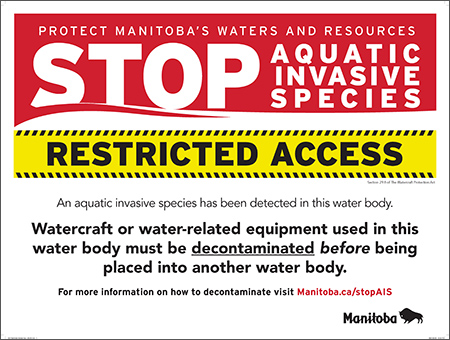
An example of a type of Restricted Access sign
Aquatic Invasive Species (AIS) Detections
Water Bodies with AIS Detections
The AIS Unit and partners conduct annual monitoring for zebra mussels and spiny waterflea. As well, members of the public assist by reporting AIS sightings. The AIS Unit verifies all sightings prior to confirming as a new detection.
Table 1. Manitoba water bodies where zebra mussel, spiny waterflea, rusty crayfish or black algae have been detected, the year the AIS was detected and the corresponding AIS requirement (e.g., under a control zone designation, restricted access designation). Note: control zones include all tributaries to the first impassible barrier.
AIS Control Zone information and map.
| Water body | AIS | Year Detected | Requirement |
|---|---|---|---|
| Assean Lake (northwest of Split Lake) | Zebra Mussel | 2019 | Restricted Access |
| Birch River (in southeast MB near Prawda) | Rusty Crayfish | 2011 | Possession of crayfish is prohibited |
| Betula Lake | Black Algae | 2003 | Control Zone |
| Buffalo Bay (MB portion of Lake of the Woods) | Rusty Crayfish | 2021 | Possession of crayfish is prohibited |
| Spiny Waterflea | 1995 | Control Zone | |
| Cedar Lake (specifically Cross Bay) | Spiny Waterflea | 2020 | Control Zone |
| Zebra Mussel | 2015; confirmed 2021 | Control Zone | |
| Cedar Lake (proper) | Spiny Waterflea | 2020 | Control Zone |
| Ebb and Flow Lake (bay of Lake Manitoba) | Zebra Mussel | 2022 | Control Zone |
| Echimamish River (downstream of Hairy Lake) | Zebra Mussel | 2021 | Control Zone |
| Falcon Lake | Rusty Crayfish | 2007 | Possession of crayfish is prohibited |
| Foot Print Lake (directly north of Cedar Lake's Cross Bay) | Spiny Waterflea | 2022 | Restricted Access |
| Lake Manitoba | Zebra Mussel | 2021 | Control Zone |
| Lake of the Woods (MB portion i.e., Buffalo Bay) | Spiny Waterflea | 1990s | Control Zone |
| Lake Winnipeg | Zebra Mussel | 2013 | Control Zone |
| Spiny Waterflea | 2011 | Control Zone | |
| Nelson River | Zebra Mussel | 2019 | Control Zone |
| Nelson River (specifically Playgreen Lake) | Spiny Waterflea | 2014 | Control Zone |
| Red River | Zebra Mussel | 2015 | Control Zone |
| Saskatchewan River (downstream of the Grand Rapids Generating Station to its entrance into Lake Winnipeg) | Spiny Waterflea | 2012 | Control Zone |
| Zebra Mussel | 2019 | Control Zone | |
| Shoal Lake (in southeast MB on MB/ON border) | Spiny Waterflea | 2018 | Control Zone |
| St. Malo Reservoir | Zebra Mussel | 2024 | Restricted Access |
| Walker Lake | Spiny Waterflea | 2022 | Control Zone |
| White Lake | Black Algae | 2003 | Control Zone |
| Winnipeg River (including all lakes, rivers, channels and other water bodies through which the Winnipeg River passes; e.g., Lee River, Lac du Bonnet and Pinawa Channel) | Spiny Waterflea | 2009 | Control Zone |
| Of Note: | |||
| Lake of the Woods (Ontario portion) | Spiny Waterflea | 1995 | See Ontario government |
| Rusty Crayfish | See Ontario government | ||
| Lake of the Woods (U.S. portion) | Zebra Mussel | 2019 | See Minnesota government |
| Winnipeg River (Ontario portion) | Spiny Waterflea | Approx. 2009 | See Ontario government |
Recent Confirmed AIS Detections
2024
Location: St. Malo Reservoir
AIS: Zebra Mussels
Year Detected: 2024
Cause of Invasion: Human-mediated transport
AIS Requirement: Restrict Access
2022
Location: Ebb and Flow Lake (a bay located on the west side of Lake Manitoba; Southern Manitoba)
AIS: Zebra Mussels
Year Detected: 2022
Cause of Invasion: Human-mediated transport
AIS Requirement: TBA
Location: Echimamish River (runs east-west between the Hayes River and the Nelson River in northern Manitoba)
AIS: Zebra Mussels
Year Detected: 2022
Cause of Invasion: Human-mediated transport
AIS Requirement: The Echimamish River is a tributary of the Nelson River and that portion up to the first impassable barrier is part of the Nelson River Control Zone.
Location: Foot Print Lake (located immediately north of Cedar Lake; Central Manitoba)
AIS: Spiny Waterflea
Year Detected: 2022
Cause of Invasion: Human-mediated transport
AIS Requirement: Restricted Access
Location: Walker Lake (flows into Cross Lake/Nelson River)
AIS: Spiny Waterflea
Year Detected: 2022
Cause of Invasion: Human-mediated transport
AIS Requirement: Walker Lake is part of the Nelson River Control Zone.
2021
Location: Cross Bay portion of Cedar Lake (Central Manitoba)
AIS: Zebra Mussels
Year Detected: 2015; re-confirmed in 2021
Cause of Invasion: Human-mediated transport
AIS Requirement: Saskatchewan / Cedar Lake Control Zone
Location: Lake Manitoba
AIS: Zebra Mussels
Year Detected: 2021
Cause of Invasion: Human-mediated transport
AIS Requirement: Designated with restricted access to prevent the spread of zebra mussels to other water bodies. As such, decontamination is required before placing watercraft and water-related equipment used in Lake Manitoba into another water body.
Protecting Upstream Areas from an AIS Invasion
Zebra mussels and spiny waterflea cannot move against the natural flow of water. However, AIS can gain access to upstream areas by human transport.
Your actions can prevent upstream AIS invasions. Always start in an upstream area of a water body and end in a downstream area.
For example, if traveling within Cedar Lake always move from a non-invaded area (i.e., Cedar Lake proper) and end in the invaded area (i.e., Cross Bay portion of Cedar Lake). This action will prevent the human transport of AIS upstream into Cedar Lake proper and the Saskatchewan River.
Restricted Access
Restricted access signs (as shown below) are placed at access points of invaded water bodies that are not yet designated as AIS Control Zone. The signs are to notify surface water users of this decontamination requirement.
Need Help?
The open-water season, winter (ice-covered) season and float plane operators checklists are resources that can help you comply with AIS requirements.