 |
Labour and Immigration
FAQs: Asbestos Containing Material
Risks to Health from Asbestos Containing Material (ACM)
Asbestos presents a potential lung disease hazard when released into the air and inhaled. People exposed to asbestos have developed several types of life-threatening diseases, including asbestosis, lung cancer and mesothelioma.
Where is ACM Found?
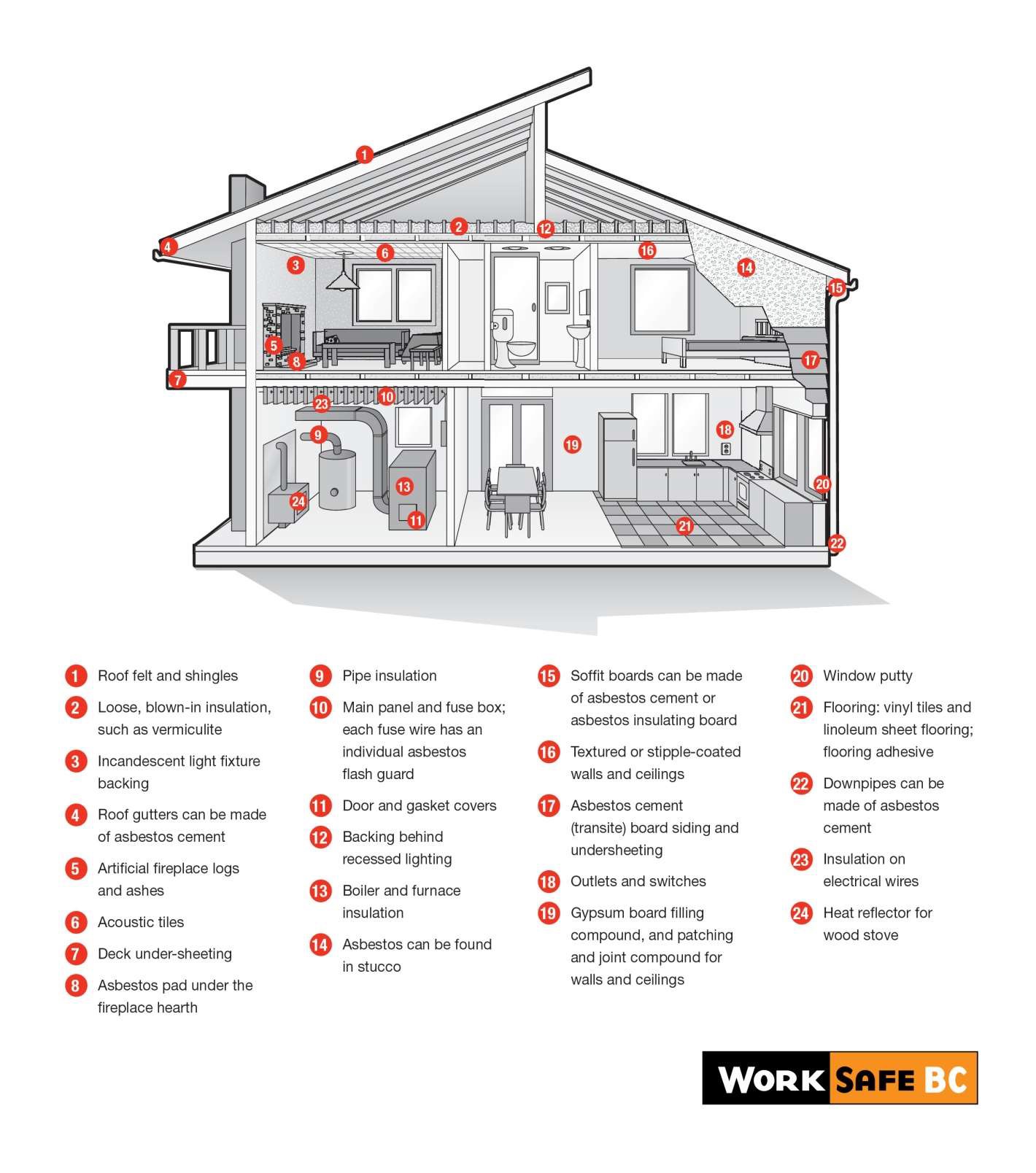
ACM has been used in thousands of building materials in structures, homes and buildings built or renovated prior to 1990 and is still used today in some applications although most applications have now been banned in Canada (2018). Figure 1 (over) contains examples of commonly found ACM.
Legal Requirements for ACM
Manitoba's Workplace Safety and Health Regulation (the Regulation) has requirements for asbestos management and abatement. Parts 6, 33, 35, 36 and 37 of the Regulation describe what is required prior to, during and after renovation, demolition or alteration of structures with ACM. Full regulatory requirements can be found at: www.manitoba.ca/labour/safety/wshl
As per the WSH Regulation, if ACM is suspected of being present, and prior to any work being done, the property owner, contractor or employer must ensure:
- The work area is inspected and an asbestos inventory prepared by a person competent in identifying ACM. The inventory identifies the locations, types and condition of all ACM in the workplace (Part 37.3).
- ACM that is damaged or in poor condition must be immediately addressed as per 37.3(3)
- All materials likely to contain asbestos are treated as ACM unless the material is found not to be ACM (Part 37.2(2)). A competent person (a person possessing the knowledge, experience and training needed to perform a specific duty) collects representative bulk samples of suspected ACM for analysis by an accredited laboratory for a definitive result,
- Workplace Safety and Health is notified at least 5 days but not more than 10 days before starting work that may release ACM into the air. (Part 37.9(2)). Notify Workplace Safety and Health online at: https://www.gov.mb.ca/labour/safety/permits.html.
- Asbestos that will be disturbed in the work area is removed prior to demolition or alteration work beginning (Part 37.9(1)).
- When ACM cannot be fully assessed and removed, such as after an emergency demolition activity because of a FIRE LOSS, the work requires control measures implemented for ACM. Control measures include wet methods to prevent airborne ACM release during handling, transport and disposal of all potentially contaminated debris as ACM.
-
An asbestos control plan is in place for handling and disposing of ACM in a manner that will prevent the release of asbestos fibres into the atmosphere (Part 37.6).
- Control measures should be developed in accordance with the level of risk (see over for information regarding levels of risk for work involving ACM).
-
Workers are trained in the safe work procedures for ACM (Part 36.3).
- Worker and supervisor training must be conducted by a competent person who should have demonstrated knowledge and experience of working with asbestos.
- Workers are provided with appropriate personal protective equipment as determined by the scope of work, and be properly fitted for respirators if, and when, they are required (Part 6.15(1)).
- Effective June 1, 2027, workers must be certified, and employers must be registered.
- Failure to comply with regulatory requirements may result in work stoppages, fines or prosecution.
Levels of Risk When Working with Asbestos
- Type 1 Low risk: non-friable materials where the release of asbestos fibres is not expected to occur when work is carried out using recommended safe work procedures for non-friable materials.
- Type 2 Moderate risk: < 1m2 friable materials are involved where the airborne release of asbestos fibres may occur and the work is to be carried out in less than 3 hours.
- Type 3 High risk: friable materials where the release of asbestos fibres is expected and the work extends beyond 3 hours
Figure 1 - Examples of commonly found ACM
Additional resources on health risks associated with ACM can be found at www.safemanitoba.com. If you have further questions about legislative requirements or would like to report unsafe work call 1-855-957-SAFE and select "Option 1" to speak to a Safety and Health Officer.
Contact the Workplace Safety & Health Branch
Phone: 204-957-SAFE (7233)
Toll-free: 1-855-957-SAFE (7233)
www.manitoba.ca/labour/safety/